Skip to content
CIHEAM
CIHEAM-60
  • EN
  • FR
toggle menu
MENUMENU
  • ABOUT US
        • ABOUT US

          • OUR HISTORY
          • GOVERNANCE
          • OUR PRIORITIES
          • OUR TOOLS
          • VACANCIES
        • Founded in 1962, the International Centre for Advanced Mediterranean Agronomic Studies (CIHEAM) is a Mediterranean intergovernmental organization composed of 13 member states (Albania, Algeria, Egypt, Spain, France, Greece, Italy, Lebanon, Malta, Morocco, Portugal, Tunisia and Turkey).

  • 2024 MINISTERIAL MEETING
        • 2024 MINISTERIAL MEETING

          • 12TH CIHEAM MINISTERIAL MEETING IN RABAT (25 OCTOBER)
          • DOCUMENTS
          • SCIENTIFIC HIGH LEVEL MEETING (24 OCTOBER)
          • MEDIA GALLERY
          • PREVIOUS MINISTERIAL MEETINGS
        •  

          Stay up-to-date on all CIHEAM‘s activities

  • MEDIA
        • Media

          • NEWS AND EVENTS
          • PRESS REVIEW (SCOOP.IT)
          • NEWSLETTERS
        •  

          Stay up-to-date on all CIHEAM‘s activities

  • EDUCATION
        • Education

          • MASTER PROGRAMMES
          • SHORT SPECIALISED COURSES
          • E-LEARNING
          • ADMISSION
          • ALUMNI
          • CIHEAM PRIZE FOR THE BEST THESIS
        •  


          Discover how to achieve your goals with the CIHEAM

  • RESEARCH & DEVELOPMENT
        • Research & Development

          • PROJECTS
          • DOCTORAL PLATFORM
          • SCIENTIFIC PRODUCTION
          • CIHEAM YOUTH INNOVATION AWARD
        • Discover how the CIHEAM contributes to scientific development

  • PUBLICATIONS
        • Publications

          • NEW MEDIT
          • MEDITERRA
          • WATCHLETTERS
          • OUR CONTRIBUTIONS
          • ACTIVITY REPORTS
        • Discover the latest CIHEAM publications

  • POLICY DIALOGUE
        • POLICY DIALOGUE

          • MINISTERIAL MEETINGS
          • INSTITUTIONAL PARTNERS
          • OUR NETWORKS AND PLATEFORMES
        • CIHEAM‘s commitment to cooperation and diplomacy

  • OUR INSTITUTES
        • OUR INSTITUTES

          • CIHEAM BARI

            CIHEAM BARI

          • CIHEAM CHANIA

            CIHEAM CHANIA

          • CIHEAM MONTPELLIER

            CIHEAM MONTPELLIER

          • CIHEAM ZARAGOZA

            CIHEAM ZARAGOZA

COP31: The Mediterranean is hungry for change
CIHEAM > AGENDAS > COP31: The Mediterranean is hungry for change

Placing populations at the heart of the transformation of Mediterranean food systems

How can Mediterranean food systems be made more resilient to climate change, while reducing their environmental footprint and strengthening economic and social inclusion? This question was at the heart of the round table organised by CIHEAM on 18 November 2026, at the Mediterranean Pavilion of COP31, in Antalya (Turkey).
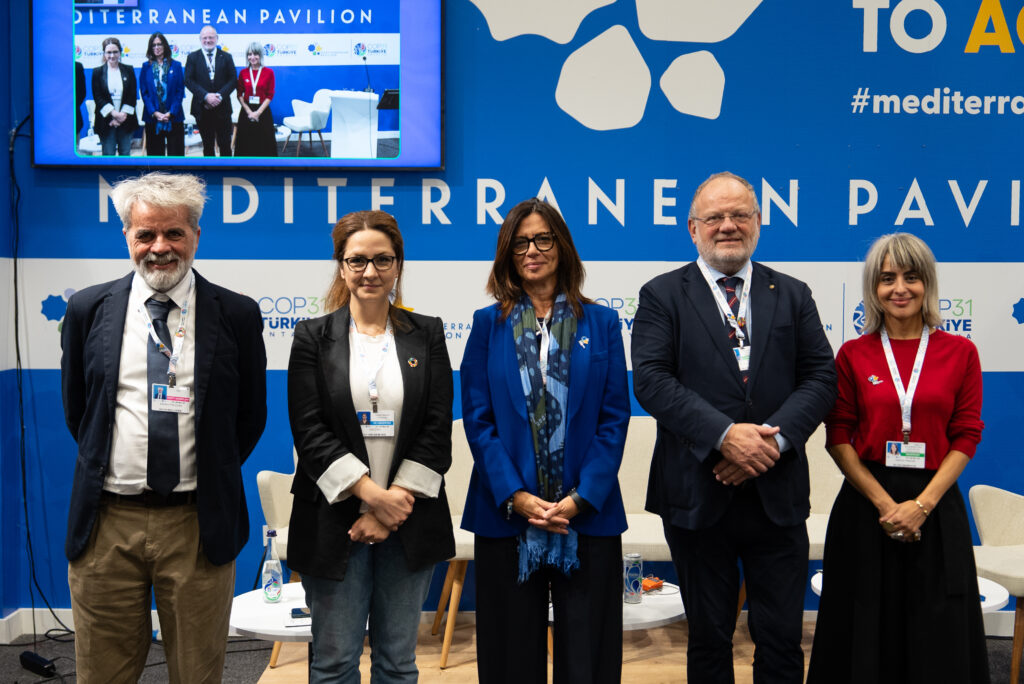
Entitled “The Mediterranean Is Hungry for Change! Putting People at the Heart of Climate-Resilient Food Systems ,” this meeting brought together Teodoro Miano , Secretary General of CIHEAM; Anna Dorangricchia , Gender Equality Programme Manager at the Union for the Mediterranean (UfM); Damiano Petruzzella , Innovation Coordinator at CIHEAM Bari; and Azin Zarei , Researcher at the United Nations University (UNU Resource Nexus). The discussions were moderated by Yasmine Seghirate , CIHEAM Administrator and Women and Youth Focal Point.

VIEW THE SESSION

Teodoro Miano emphasized that the Mediterranean diet is not simply a healthy eating pattern; it is a holistic approach that integrates production and consumption patterns, the preservation of natural resources, economic and social dimensions, and cultural heritage. He presented the Las Palmas Decalogue , updated for 2026, which proposes ten areas of action to strengthen the sustainability of the Mediterranean diet, from the affordability of food to the preservation of biodiversity, including education, innovation, and food security. This approach also informs the ongoing work towards a voluntary code of conduct for the sustainability of the Mediterranean diet. Discussions also highlighted CIHEAM's work on pulses, particularly through the BEANS network , to bridge the gap between dietary practices, climate challenges, and the expectations of younger generations.

Anna Dorangricchia presented the work of the Regional Task Force on Women Entrepreneurs in Agri-Food Systems , developed with CIHEAM and several Mediterranean partners. Analyses conducted in seven countries show that support and financing initiatives exist, but remain insufficiently coordinated and often poorly adapted to the different stages of business development, particularly in rural areas. The Task Force is therefore working on a regional agenda for 2026-2030 aimed at strengthening coordination, access to innovation and financing, and monitoring of results. She also emphasized an often underestimated obstacle: the cost of transitioning to more sustainable activities, especially for small businesses and cooperatives led by women.

For his part, Damiano Petruzzella emphasized the need to bridge the gap between research and the needs of farmers and entrepreneurs. He presented the Mediterranean Innovation Partnership (MIP) approach , which aims to develop local innovation ecosystems that bring together public institutions, researchers, businesses, investors, and support organizations. The goal is to facilitate knowledge transfer and transform innovations into accessible solutions tailored to specific territories.

Azin Zarei demonstrated how climate data, satellite observation, and ecosystem vulnerability assessment tools can contribute to better risk anticipation and guide agricultural adaptation decisions. However, she cautioned that data availability does not guarantee its effective use. Translating this data into concrete solutions requires bridging the gap between scientific knowledge and local experiences, strengthening skills, and removing institutional and financial barriers.

At the end of the discussions, the participants converged on one observation: the transition of Mediterranean food systems depends on the knowledge and innovations available, as well as our ability to make them accessible, to support their adoption and to coordinate policies and actors.


To go further

  • Session presentation and speakers – Mediterranean Pavilion
  • Decalogue Las Palmas de Gran Canaria 2026
  • BEANS Network
  • Regional task force for women
  • Mediterranean Innovation Partnership (MIP)

PHOTOS
  • Copyright
  • Site Map


CIHEAM

Centre International de Hautes études agronomiques méditerranéennes

11 Rue Newton, 75116 Paris

Mail: secretariat@ciheam.org

SUBSCRIBE TO THE CIHEAM NEWSLETTER

Or you can click here

Top