

COP 31 Sharing Water: What Future for Mediterranean Agriculture? Innovation, Governance and Cooperation in the Face of Climate Change
Faced with increasingly severe droughts and growing competition for water resources, the future of Mediterranean agriculture requires a transformation of practices, public policies, and governance models. This is the central message of the roundtable organized by CIHEAM on November 19, 2026, at the Mediterranean Pavilion of COP31 in Antalya, Turkey.
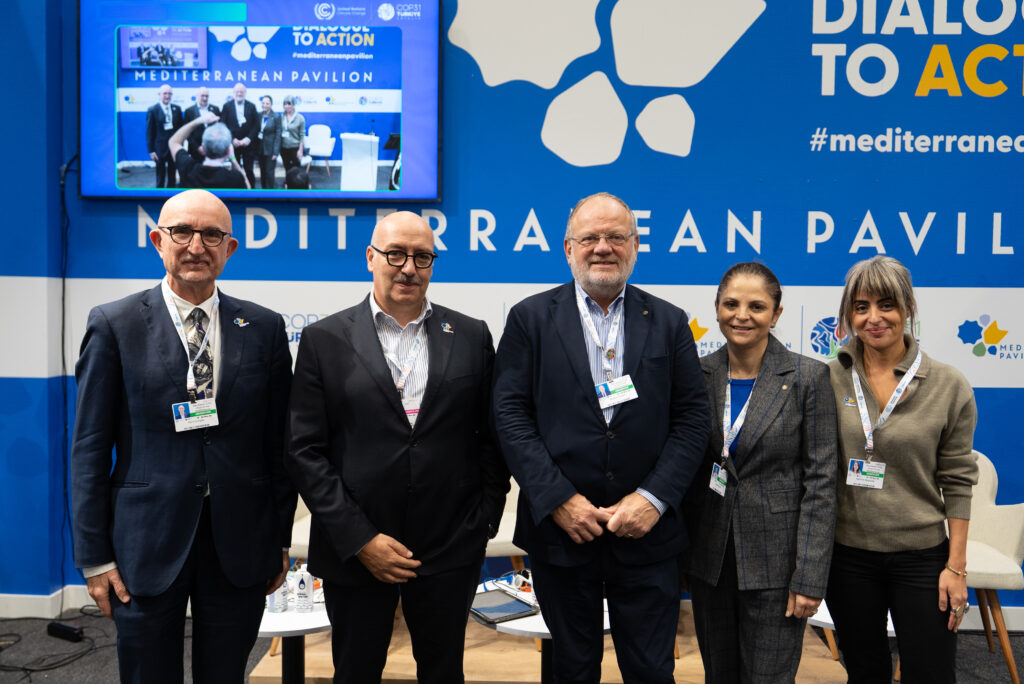
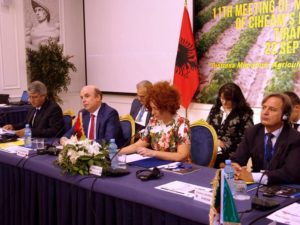
Entitled “Sharing Water: What Future for Mediterranean Agriculture? Innovation, Governance and Cooperation in the Face of Climate Change ,” this meeting brought together Teodoro Miano , Secretary General of CIHEAM; Roula Khadra , Head of the Water and Land Unit at CIHEAM Bari; Raúl Compés , Director of CIHEAM Zaragoza; and Emilio Ciarlo , Director General of the One Water Committee Italy. The discussions were moderated by Yasmine Seghirate , Administrator at the CIHEAM General Secretariat. The discussion followed on from the work carried out at the Arab Water Forum in Jeddah and the Euro-Mediterranean Water Forum in Rome, as well as the Union for the Mediterranean Ministerial Declaration on Water, adopted in September 2026 .
VIEW THE SESSION
Water scarcity is not new in the Mediterranean, but climate change is exacerbating uncertainty about the availability and quality of resources. Roula Khadra emphasized the need to combine desalination, treated wastewater reuse, precision irrigation, and nature-based solutions, taking into account their costs, environmental impacts, and territorial specificities. This diversification also requires adapting infrastructure, skills, and regulatory frameworks. It calls for an integrated approach linking water, energy, food, and ecosystems (the WEFE nexus).
Raúl Compés pointed out that improving irrigation efficiency does not necessarily guarantee a reduction in overall water consumption. Agricultural policies must therefore better integrate demand management, production choices, and trade-offs between agricultural needs, domestic uses, and ecosystem preservation. Emilio Ciarlo emphasized that the transition to sustainable solutions also requires strengthening coordination between institutions, farmers, businesses, and local authorities. He presented the concept of the Blue Common Lab , a territorial platform for consultation and investment coordination planned for Puglia, Italy. At the regional level, he advocated for a more integrated Mediterranean policy framework capable of aligning priorities, funding, and projects.
Recalling CIHEAM's commitment to irrigation and water resource management issues since its creation in 1962, Teodoro Miano emphasized the need to overcome the fragmentation of knowledge, institutions, and initiatives. He particularly highlighted the role of open innovation, based on cooperation between researchers, policymakers, economic actors, and local communities.
The discussions also highlighted the importance of involving women and young people more in water-related decisions, beyond mere declarations of principle, and of strengthening training and innovation capacities, particularly in the countries of the southern and eastern Mediterranean. At the end of the meeting, a shared conclusion emerged: solutions exist, but their implementation depends on our ability to influence policies, mobilize stakeholders, and translate knowledge into concrete actions.
To go further