
Published in Usbek & Rica on the occasion of World Food Day (16 October 2025)
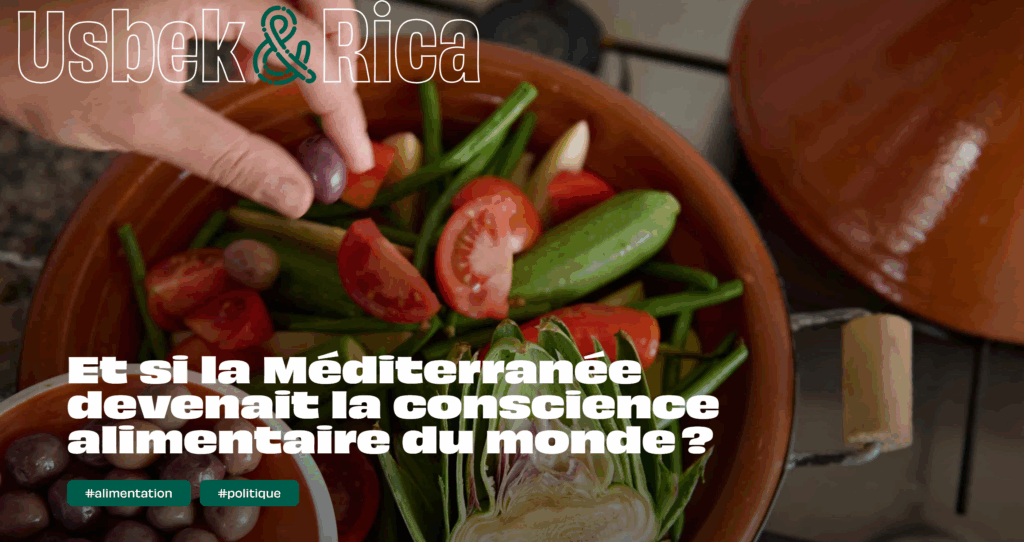
What if the Mediterranean Became the World’s Food Conscience?
Amid rising inequalities, ecological crisis, and the resurgence of hunger, the Mediterranean must reclaim its historic role as a space of exchange, balance, and innovation. A global laboratory where health, sustainability, and food justice converge. That is precisely what the International Centre for Advanced Mediterranean Agronomic Studies (CIHEAM) advocates in this op-ed, published on the occasion of World Food Day.
It has taken two global crises — health and climate — alongside regional conflicts, and persistent market volatility to remind us of an obvious truth: food security is back at the forefront, even as we thought the issue was behind us. Imports are becoming increasingly fragile, inequalities are growing both between countries and within territories. In the Mediterranean, hunger is re-emerging, and “eating well” is no longer a reality for millions of people, including those living in rural areas.
Eating is a total act — social, political, and civilizational. It crystallizes our collective choices regarding health, climate, employment, culture, and social justice. Our overstretched food systems are partly responsible for the loss of biodiversity, the disruption of water cycles, and nitrogen and phosphorus pollution. They exacerbate inequalities and threaten the ecological foundations of our survival: they feed poorly, uproot, and deplete.
And yet, the path is clear: a predominantly plant-based diet, rich in legumes, fruits, vegetables, nuts, and whole grains, combined with a moderate consumption of animal products. Flexible and culturally adaptable, this diet could prevent millions of premature deaths and ease pressure on ecosystems while restoring meaning to what it truly means “to nourish oneself.”
Rediscovering the Mediterranean Compass
Traditional diets, built on plant diversity, moderate protein intake, and strong local roots, hold part of the solution. The Mediterranean model, long celebrated as an “intangible cultural heritage,” must now be recognized as a lever for global sustainability — nutritional, climatic, and social.
However, this requires isupport through ambitious policies on food justice, rural employment, and equitable governance of water and land. Without such measures, the Mediterranean diet will remain out of reach for the most vulnerable.
A cradle of nourishing civilizations and one of the regions most exposed to climate change, the Mediterranean today serves as a magnifying mirror of global disruptions. It embodies the paradoxes of the twenty-first century: arid lands and fertile soils, ancient traditions and ultra-processed foods, abundance and insecurity, scarcity and waste. While it reflects our deadlocks, it also carries our promises.
From Fork to Farm: Shifting Perspectives
Change can no longer be confined to the fields: it must begin on our plates, in our canteens, our cities, and our schools, shaping the food environment in which consumers make their choices. The CIHEAM advocatess a “from fork to farm” approach, in which social demand, health, and the environment guide agricultural production. Returning to the Mediterranean diet is not an exercise in nostalgia — it is about restoring dignity and diversity at the heart of the food system.
In the Mediterranean, as elsewhere, we have long confused agricultural policy with food policy. We have produced more, at lower cost — but at the expense of life itself. We have standardized nature, commodified taste, and forgotten that to nourish oneself is, above all, to inhabit the world. The goal is not to pit productivism against agroecology, but to reconcile the plurality of agricultures: those that feed local territories and those that supply markets, those of smallholders and those of innovators, those that adapt to the constraints of water, soil, and climate.
Above all, we must make visible those whom the system tends to erase — young people, women, agricultural workers, and rural communities — for no sustainability can be achieved without equity. Returning to the Mediterranean diet is not about looking back, but about rethinking value chains, food education, agricultural working conditions, and the fair distribution between those who produce, process, and consume. It is about placing human dignity and diversity at the core of our food systems.
The Mediterranean: A Global Laboratory for Transition
Since antiquity, the Mediterranean has been a "sea-world". A crossroads of civilizations, it wove the earliest threads of globalization by facilitiating the circulation of plants, techniques, goods, and ideas. Between Europe, Africa, and Asia, it has always been an open space, a place of cultural exchange and innovation.
Today, it can once again become a laboratory for food and water transition, where ancient wisdom and innovation complement each another to prepare a fairer and more sustainable future. Its universities, farmers, businesses, and citizens hold a unique wealth of knowledge and cooperation, ready to be shared with the rest of the world.
On the ground, initiatives are multiplying: integrated water management, local diets, short supply chains, and innovations for sustainable agri-food systems. These experiences demonstrate that an alternative path is possible — one of shared food sovereignty, based on cooperation rather than competition. It is essential to understand that the food transition will emerge neither from markets nor from technology alone. It requires food diplomacy, a governance model that connects science, politics, and civil society to produce, exchange, and consume differently.
At a time when the planet is exceeding its ecological limits, the Mediterranean can remind the world that food is, above all, a bond, not a commodity. It can once again become a space of exchange and experimentation where food nourishes peace, culture, and human dignity. On this 16 October, World Food Day, the CIHEAM calls for the Mediterranean to become a hub of global food justice, a place where the reconciliation between bread, peace, and the planet can finally take shape.
Signatories:
Teodoro Miano, Secretary-General of the CIHEAM
Roberto Capone, CIHEAM Focal Point for Sustainable Food Systems and the Mediterranean Diet
Yasmine Seghirate, CIHEAM Focal Point for Women’s and Youth Leadership in Agri-Food Transitions