





Justice in the Fields and in Our Plates: Putting Women's Rights at the Heart of Food Systems Transformation
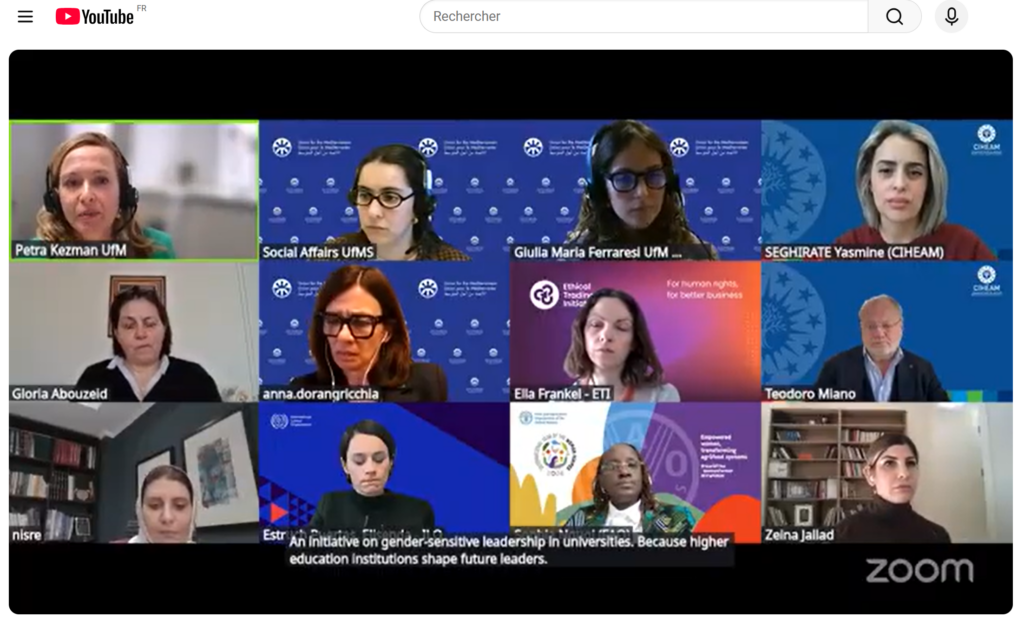
On 5 March 2026, the CIHEAM and the Union for the Mediterranean (UfM) jointly organised the online webinar “Justice in the Fields and in our Plates: Women’s Rights as a Driver of Sustainable Food Systems Transitions”, within the SFS-MED Platform.
Watch Webinar here
Held in the context of the International Year of the Woman Farmer 2026 and ahead of International Women’s Day, which this year is under the theme “Rights. Justice. Action. For ALL Women and Girls”, the discussion brought together around 100 Mediterranean stakeholders to reflect on a question that is increasingly central to food systems debates: how can women’s access to justice in rural and agrifood contexts become a real driver of fairer, more resilient and sustainable food systems?
In the opening session, CIHEAM Secretary General, Teodoro Miano, framed the discussion recalling that “Justice is not a peripheral concern. It is a structural condition for food systems transformation. Removing the barriers that limit women’s rights in agrifood systems is therefore essential not only for gender equality, but for the resilience and sustainability of Mediterranean food systems as a whole.”
Why justice matters for food systems
Setting the policy context, Elisenda Estruch, Rural Economy Specialist at the International Labour Organization (ILO), highlighted that gender gaps in legal protection, labour conditions and access to productive resources directly affect food security, nutrition outcomes and rural resilience. In a region facing climate stress and fragile livelihoods, unequal access to land, decent work and social protection does not only undermine women’s rights – it weakens the adaptive capacity of agrifood systems as a whole.
Structural barriers and operational pathways
The interventions during the panel discussion examined justice gaps across land, labour, finance and governance frameworks.
Gloria Abouzeid, Director General of Cooperatives at Lebanon’s Ministry of Agriculture, addressed cooperative governance and institutional reforms needed to strengthen women farmers’ representation and access to services.
Nisreen Lahham, from the Food and Agriculture Organisation Regional Office for the Near East and North Africa (FAO RNE) discussed evidence-based financial instruments that improve rural women’s access to credit and income opportunities, stressing that inclusive finance must be embedded in accountable institutional systems.
From a supply-chain perspective, Ella Frankel of the Ethical Trading Initiative highlighted persistent justice gaps in informal labour contexts, including limited access to grievance mechanisms and weak protection from retaliation, calling for operational corporate responsibilities and gender-responsive remedies.
Finally, Dr. Zeina Jallad, Director of Palestine Land Studies Center at AUB examined structural barriers related to land tenure and inheritance, underscoring how discriminatory practices and procedural obstacles constitute systemic risks to food security and rural stability, particularly in fragile settings.
Across contributions, a shared conclusion emerged: access to justice in agrifood systems extends beyond courts. It encompasses land administration, labour inspection, cooperative governance, financial regulation and food policy accountability. Legal reforms alone are insufficient without enforceability, institutional capacity and protection against retaliation.
A priority agenda for the International Year of the Woman Farmer
In a final collective reflection linked to the International Year of the Woman Farmer 2026, speakers emphasized the importance of elevating access to justice as a measurable pillar within national and regional food systems strategies. Sophia Ngugi, Gender Officer at the FAO, outlined key priorities for this International Year of the Woman Farmer 2026, including strengthening land tenure security, embedding gender-responsive labour justice mechanisms, expanding legal empowerment services, and integrating accountability indicators into agrifood governance frameworks.
The webinar directly advanced the mandate emerging from the UfM Regional Stakeholder Dialogue and Training on Empowering Women Entrepreneurs in the MENA Agro-Food Sector through Social and Technological Innovation convened in Cairo in October 2025, which resulted in the Joint UfM-CIHEAM Declaration Commitment to a Regional Agenda on Innovation for Women Entrepreneurs in the Agro-Food Value Chain in the Euro-Mediterranean Region, as a regional commitment to work toward more inclusive, sustainable, and resilient agro-food supply chains.
By situating access to justice within the broader regional agenda, the Webinar discussion reinforced the need to translate political commitments into operational reforms. In this regard, the International Year of the Woman Farmer 2026 was positioned not as a symbolic milestone, but as a catalyst for advocacy and measurable implementation across Mediterranean agrifood systems – ensuring that women’s economic empowerment is supported by legal security, institutional accountability and effective remedies.