

MONALISA: The CIHEAM Highlights Soil Resilience and Anti-Desertification Solutions at the CGDD National Webinar under the Horizon Europe Programme
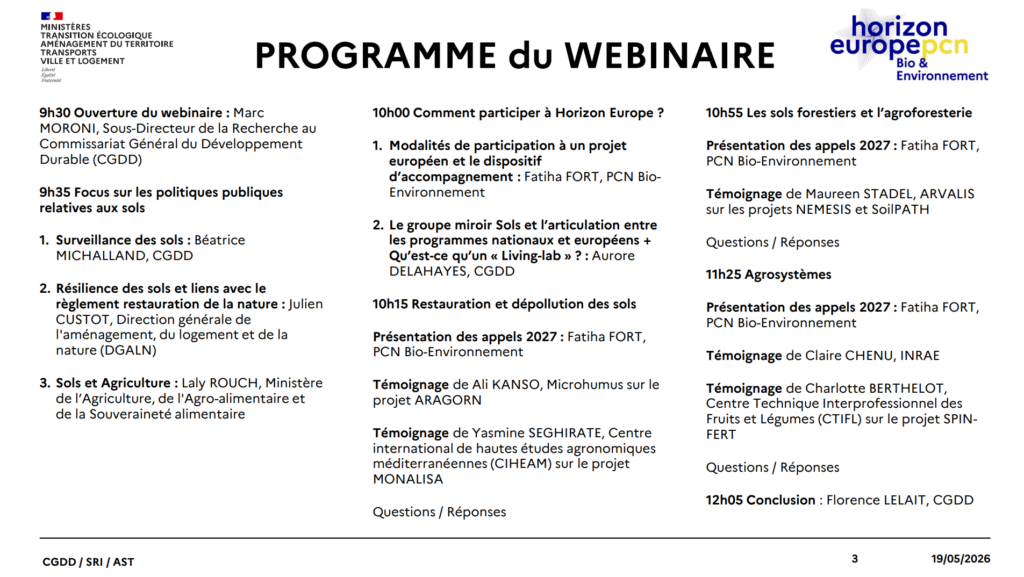
On 19 May 2026, the CIHEAM presented the MONALISA project during the webinar organised by the General Commission for Sustainable Development (CGDD) of the French Ministry of Ecological Transition, dedicated to future "SOILS" calls for proposals under the Horizon Europe programme. This event brought together key stakeholders from research, businesses, and local authorities to discuss the major challenges of monitoring, decontaminating, and sustainably managing European soils.
Organised in collaboration with the Bio-Environment National Contact Point (NCP), this webinar was opened by Marc Moroni, Deputy Director of Research at the CGDD. The event aimed to mobilize French stakeholders regarding European Union funding opportunities, while outlining the current state of national and European regulatory dynamics, notably driven by the new directive on soil monitoring and resilience (Soil Monitoring Law) adopted in November, 2025.
Sharing experiences and highlighting the MONALISA project
Yasmine Seghirate, Administrator at the CIHEAM General Secretariat, spoke to present the scientific objectives and the framework of action for the Euro-Mediterranean MONALISA project.
Funded by the European Union with 6.99 million euros (for a total budget of €7.3M) and spanning a period of 48 months (September 2024 - August 2028), the MONALISA project is coordinated by the University of Sassari (UNISS) and brings together 22 partners from 9 countries. Its central ambition is to design, test, and promote innovative solutions—rooted in Nature-based Solutions and cutting-edge digital technologies—to halt land degradation and desertification in the arid regions of the Mediterranean and Europe, through 6 concrete case studies (Italy, Spain, Palestine, Greece, Tunisia).
Within this strategic consortium, the CIHEAM leads Work Package 5 (WP5), dedicated to dissemination, communication, exploitation of results, and capacity building. The CIHEAM jointly mobilizes the expertise of the CIHEAM Bari and its General Secretariat to bridge the gap between scientific research of excellence, territorial cooperation, and the dissemination of recommendations to Euro-Mediterranean policymakers.
A collective mobilization for the objectives of the "Soil Mission"
The webinar also provided an opportunity to hear valuable testimonies from other leading organisations committed to the ecological transition:
- Microhumus, represented by Ali Kanso, presented the ARAGORN project, which focuses on the transition from traditional remediation to "restorative" and functional remediation of contaminated soils (particularly by heavy metals and PFAS).
- ARVALIS, through Maureen Stadel, shared the keys to success and management in setting up collaborative projects through feedback from the NEMESIS (creation of autonomous Living Lab networks) and SoilPATH (quantification of the impact of field crop practices on soil health) initiatives.
- INRAE, represented by Professor Claire Chenu, shared the highly successful results of the European Joint Programme EJP SOIL, a major pioneer in the structuring and harmonized sharing of soil data in Europe.
These interventions highlighted the crucial importance of the Living Labs concept promoted by the EU Soil Mission (A Soil Deal for Europe), which aims to break down traditional research silos by placing end-users—farmers, land managers, businesses, and local authorities—at the very heart of the co-creation and innovation experimentation process.
Funded by the European Union. Views and opinions expressed are however those of the author(s) only and do not necessarily reflect those of the European Union or the European Research Executive Agency (REA). Neither the European Union nor the granting authority can be held responsible for them.